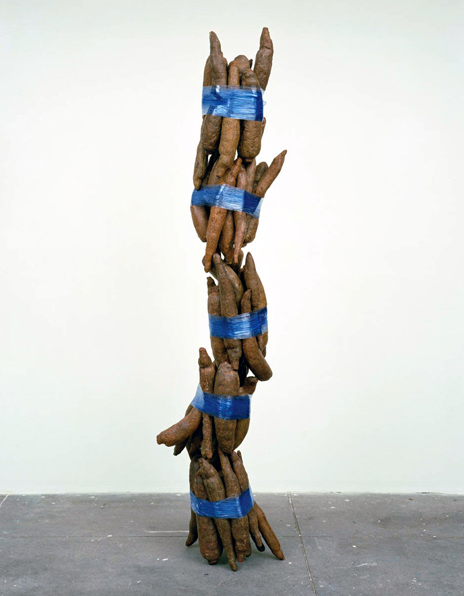
Franz West Adaptive 2003
Thursday, 21 July 2011
Sunday, 17 July 2011
Thursday, 14 July 2011
Gordon Matta Clark - Food
Tina Girouard, Carol Goodden, and Gordon Matta-Clark in front of Food, restaurant, New York, 1971
Photograph by Richard Landry, writing by Gordon Matta-Clark.
Wednesday, 6 July 2011
Thursday, 30 June 2011
Michel Foucault on Heterotopias
Heterotopias
First there are the utopias. Utopias are sites with no real place. They are sites that have a general relation of direct or inverted analogy with the real space of Society. They present society itself in a perfected form, or else society turned upside down, but in any case these utopias are fundamentally unreal spaces.
There are also, probably in every culture, in every civilization, real places - places that do exist and that are formed in the very founding of society - which are something like counter-sites, a kind of effectively enacted utopia in which the real sites, all the other real sites that can be found within the culture, are simultaneously represented, contested, and inverted. Places of this kind are outside of all places, even though it may be possible to indicate their location in reality. Because these places are absolutely different from all the sites that they reflect and speak about, I shall call them, by way of contrast to utopias, heterotopias. I believe that between utopias and these quite other sites, these heterotopias, there might be a sort of mixed, joint experience, which would be the mirror. The mirror is, after all, a utopia, since it is a placeless place. In the mirror, I see myself there where I am not, in an unreal, virtual space that opens up behind the surface; I am over there, there where I am not, a sort of shadow that gives my own visibility to myself, that enables me to see myself there where I am absent: such is the utopia of the mirror. But it is also a heterotopia in so far as the mirror does exist in reality, where it exerts a sort of counteraction on the position that I occupy. From the standpoint of the mirror I discover my absence from the place where I am since I see myself over there. Starting from this gaze that is, as it were, directed toward me, from the ground of this virtual space that is on the other side of the glass, I come back toward myself; I begin again to direct my eyes toward myself and to reconstitute myself there where I am. The mirror functions as a heterotopia in this respect: it makes this place that I occupy at the moment when I look at myself in the glass at once absolutely real, connected with all the space that surrounds it, and absolutely unreal, since in order to be perceived it has to pass through this virtual point which is over there.
Michelangelo Pistoletto - Seventeen One Less
(2009, Installation & Performance at the 53rd Venice Biennale)
Wednesday, 29 June 2011
Friday, 24 June 2011
Friday, 17 June 2011
Sunday, 12 June 2011
Thursday, 9 June 2011
Friday, 3 June 2011
Saturday, 28 May 2011
Monday, 23 May 2011
Sunday, 22 May 2011
Thursday, 19 May 2011
Monday, 16 May 2011
Sunday, 15 May 2011
Saturday, 14 May 2011
Wednesday, 11 May 2011
John Baldessari - Portrait: (Self) #1 as Control + 11 Alterations by Retouching and Airbrushing
John Baldessari Portrait: (Self) #1 as Control + 11 Alterations by Retouching and Airbrushing 1974
Thursday, 5 May 2011
Monday, 2 May 2011
Sunday, 1 May 2011
Wednesday, 27 April 2011
Jean Baudrillard - Simulations and Simulacra
The simulacrum is never that which conceals the truth — it is the truth which conceals that there is none.
The simulacrum is true.
Ecclesiastes
The simulacrum is true.
Ecclesiastes
If we were able to take as the finest allegory of simulation the Borges tale where the cartographers of the Empire draw up a map so detailed that it ends up exactly covering the territory (but where, with the decline of the Empire this map becomes frayed and finally ruined, a few shreds still discernible in the deserts — the metaphysical beauty of this ruined abstraction, bearing witness to an imperial pride and rotting like a carcass, returning to the substance of the soil, rather as an aging double ends up being confused with the real thing), this fable would then have come full circle for us, and now has nothing but the discrete charm of second-order simulacra.
Abstraction today is no longer that of the map, the double, the mirror or the concept. Simulation is no longer that of a territory, a referential being or a substance. It is the generation by models of a real without origin or reality: a hyperreal. The territory no longer precedes the map, nor survives it. Henceforth, it is the map that precedes the territory — precession of simulacra — it is the map that engenders the territory and if we were to revive the fable today, it would be the territory whose shreds are slowly rotting across the map. It is the real, and not the map, whose vestiges subsist here and there, in the deserts which are no longer those of the Empire, but our own. The desert of the real itself.
Thursday, 21 April 2011
Monday, 18 April 2011
Wednesday, 13 April 2011
Tuesday, 12 April 2011
Sunday, 10 April 2011
Matt McCormick - The Subconscious Art of Graffiti Removal
the subconscious art of graffiti removal (excerpt) from matt mccormick on Vimeo.
16mm/Digital video – 16 minutes – 2001
Subscribe to:
Posts (Atom)